
insights
Electricity Made Simple: Current, Voltage and Resistance for Class 10
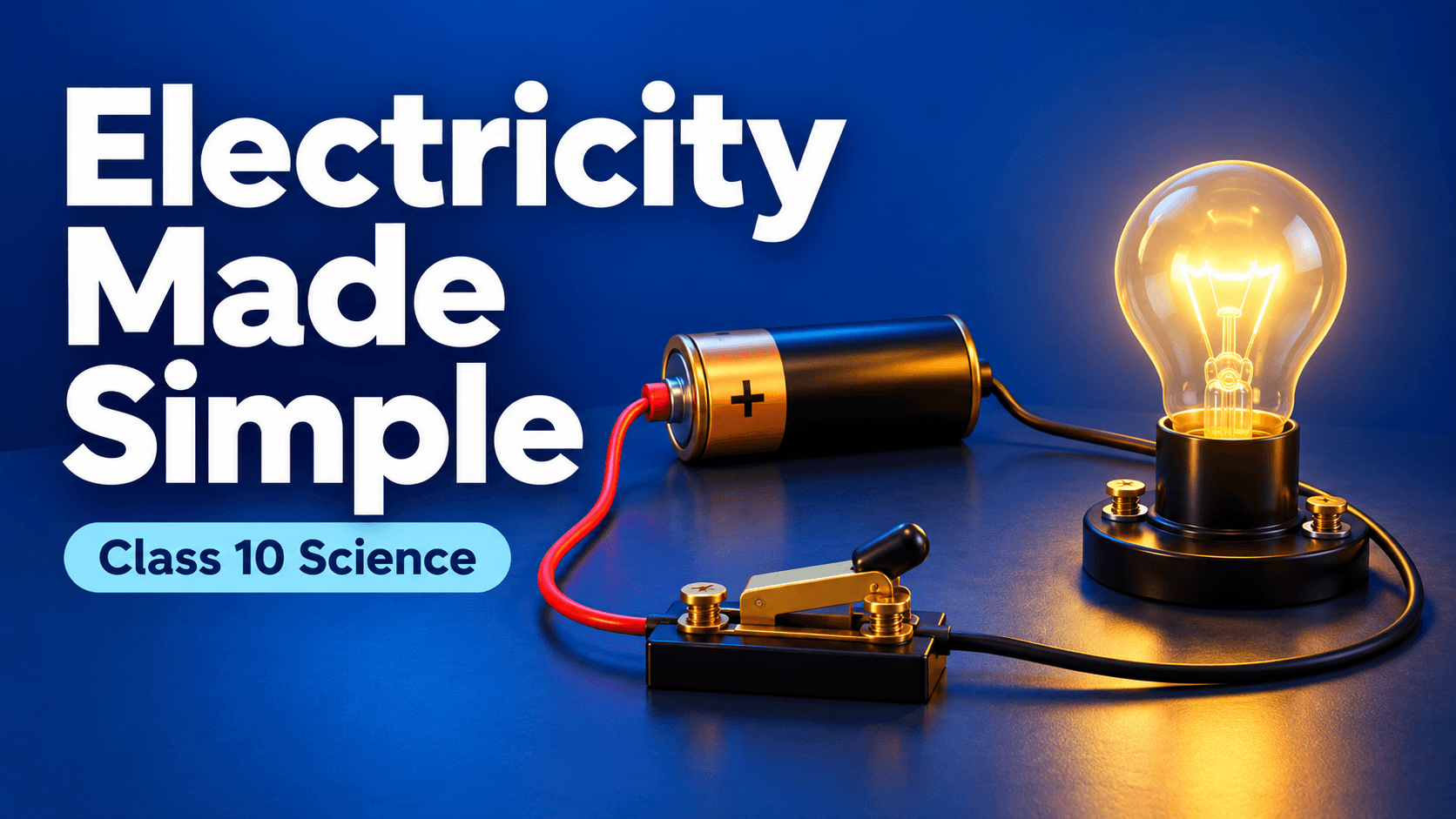
## Why does a bulb glow when you close a switch?
Closing the switch completes a conducting path between the battery’s terminals. Charge flows through the circuit, and the bulb converts electrical energy into light and heat.
To understand this process, start with three ideas: **current, potential difference, and resistance**.
## 1. Current: the rate of flow of charge
Electric current tells us how much charge passes through a cross-section of a conductor each second.
**I = Q / t**
- **I:** current, measured in amperes (A)
- **Q:** charge, measured in coulombs (C)
- **t:** time, measured in seconds (s)
If 6 coulombs of charge pass through a wire in 3 seconds:
**I = 6 / 3 = 2 A**
Remember: current is a rate of charge flow. It is not the speed of individual electrons.
## 2. Voltage: energy transferred per unit charge
Potential difference, commonly called voltage, tells us how much energy is transferred per unit charge between two points.
**V = W / Q**
Here, W is the energy transferred in joules, and Q is the charge in coulombs.
A potential difference of **3 V** means **3 joules of energy are transferred per coulomb of charge**.
A battery maintains a potential difference between its terminals. A complete conducting path allows a sustained current to flow.
## 3. Resistance: opposition to current
Resistance describes how strongly a component opposes electric current. Its unit is the **ohm (Ω)**.
For the same potential difference:
- Higher resistance means lower current.
- Lower resistance means higher current.
For wires of the same material at the same temperature, a longer wire has greater resistance, while a thicker wire has lower resistance.
## 4. Ohm’s law: connecting the three ideas
Ohm’s law states that the current through a conductor is directly proportional to the potential difference across it, provided its temperature and other physical conditions remain constant.
**V = IR**
Rearrange this equation depending on what you need:
- To find voltage: **V = IR**
- To find current: **I = V / R**
- To find resistance: **R = V / I**
**Worked example**
A 6 Ω resistor is connected across a 12 V supply. Find the current.
Given:
- V = 12 V
- R = 6 Ω
Therefore:
**I = V / R = 12 / 6 = 2 A**
If the resistance increases to 12 Ω while the voltage stays at 12 V, the current falls to **1 A**.
> Exam tip: Write the given quantities, choose the formula, substitute the values, and include the correct unit in your answer.
## 5. Series and parallel: what stays the same?
**In a series circuit**, components are connected along a single path.
- The same current passes through every component.
- The supply voltage is shared across the components.
- Total resistance: **R = R₁ + R₂ + …**
**In a parallel circuit**, components are connected across the same two points.
- Each branch has the same potential difference.
- The total current divides between the branches.
- Total resistance: **1/R = 1/R₁ + 1/R₂ + …**
Household appliances are connected in parallel so each receives the supply voltage and can operate independently.
## 6. Three mistakes to avoid
**“A bulb uses up current.”**
A bulb transfers electrical energy into light and heat. In a steady circuit, charge does not disappear inside it.
**“Voltage flows through a wire.”**
Charge flows. Voltage is a potential difference between two points.
**“Ohm’s law applies to every component under every condition.”**
The conditions matter. For example, a filament bulb heats up as current increases, changing its resistance.
## Test yourself
1. A charge of 20 C passes through a wire in 5 s. What is the current?
2. A 4 Ω resistor carries a current of 3 A. What is the voltage across it?
3. Two resistors, 2 Ω and 3 Ω, are connected in series. Find their total resistance.
4. Two 6 Ω resistors are connected in parallel. Find their total resistance.
**Answers**
1. I = 20 / 5 = **4 A**
2. V = 3 × 4 = **12 V**
3. R = 2 + 3 = **5 Ω**
4. 1/R = 1/6 + 1/6 = 1/3, so R = **3 Ω**
## Your five-minute revision task
Close your notes and explain current, voltage, and resistance in one sentence each. Then solve the four questions again without looking at the answers.
If you can explain the ideas and use the equations, you are building understanding that lasts beyond the exam.